It's easy to take for granted the invisible framework that holds our favorite songs together. We hum melodies, tap rhythms, and feel the emotion, but often overlook the quiet architect behind it all: the chord progression. Understanding Chord Progressions for Different Music Genres isn't just a technical exercise; it's unlocking the emotional cheat codes of music, revealing why a blues song feels earthy, a pop tune hooks you instantly, or a jazz piece makes you want to drift away. These sequences of chords don't just fill space; they define mood, build tension, create release, and ultimately, sculpt the very sound and identity of a genre.
From the raw power of a three-chord rock anthem to the intricate dance of a jazz standard, progressions are the harmonic backbone, guiding listeners on a sonic journey. They’re the secret sauce that makes a chorus soar and a verse ponder.
At a Glance: Crafting Emotion with Chords
- Chord progressions are sequential chords that form a song's harmonic structure, dictating its mood and narrative.
- They operate on tension and resolution, moving from stable "home" chords to those that create anticipation, then back to rest.
- Roman numerals (I, IV, V, ii, vi, etc.) provide a universal language to describe progressions in any key, making them transposable.
- Each genre leans on specific progressions or variations, giving it a distinctive feel—from pop's catchy hooks to jazz's sophisticated swings.
- Mastering common progressions is your gateway to understanding music and creating your own unique soundscapes.
- Beyond the basics, you can add your own twist by altering rhythm, adding extensions, substituting chords, or combining patterns.
The Unsung Heroes of Music: Why Progressions Matter So Much
Think of a song as a story. The melody might be the main character, and the rhythm its pace, but the chord progression is the plot itself—the emotional arc, the rising action, the climax, and the resolution. Without it, music would feel aimless, lacking direction and emotional depth. A well-crafted progression guides your ear, creating expectations and satisfying them in just the right way.
Musicians rely on these patterns to build harmonies, ensure smooth transitions between sections, and craft melodies that resonate deeply. They’re not just random choices; they’re carefully selected sequences that leverage the natural relationships between chords within a key. Some chords feel like "home," stable and resolved. Others introduce a sense of yearning, a need to move somewhere else. The magic happens in the journey between these points.
The Foundation: Understanding Chords, Keys, and Roman Numerals
Before we dive into the specific flavors of different genres, let's quickly lay the groundwork.
A chord is simply a group of notes played together that sound harmonious. A chord progression is a series of these chords played one after another. What makes them "work" is their relationship within a specific key or scale.
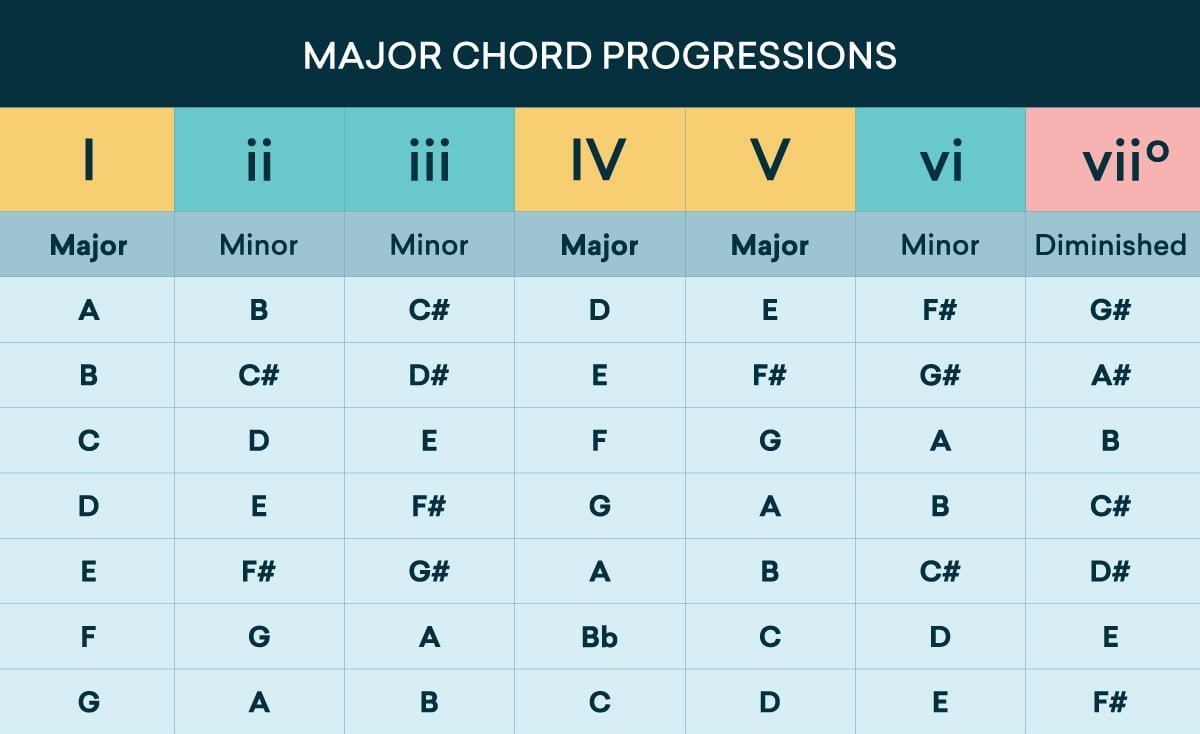
Every key has a set of natural chords derived from its scale. For example, in the key of C Major, the major scale notes are C-D-E-F-G-A-B. From these notes, we build seven basic chords:
- C Major (C-E-G)
- D minor (D-F-A)
- E minor (E-G-B)
- F Major (F-A-C)
- G Major (G-B-D)
- A minor (A-C-E)
- B diminished (B-D-F)
To talk about these chords universally, musicians use Roman numerals. This system instantly tells you the chord's function within any key, rather than its absolute name. It's like a universal translator for harmony. - Uppercase Roman numerals (I, IV, V) denote major chords. These are the most stable and foundational.
- Lowercase Roman numerals (ii, iii, vi) denote minor chords, adding emotional color or introspection.
- The diminished chord (vii°) creates strong tension, often leading back to the "home" chord (I).
So, if you see "I-V-vi-IV," you know what to play in any key. In C major, it's C-G-Am-F. In G major, it's G-D-Em-C. This system is incredibly powerful for understanding and transposing music across genres.
The Building Blocks: 8 Essential Chord Progressions and Their Vibe
These eight progressions are your harmonic toolkit. They're the most common, versatile, and instantly recognizable patterns that have shaped countless hits across various genres.
1. The Pop-Punk Progression: I-V-vi-IV
- Vibe: Catchy, anthemic, sometimes a little melancholic but always driving forward.
- Why it works: This progression is a modern pop staple because it balances stability (I), dominant tension (V), emotional depth (vi), and a solid subdominant pull (IV) that naturally leads back to I. It feels familiar yet satisfying.
- Example (C Major): C-G-Am-F
- Heard in: Modern pop, rock, indie, pop-punk. Think Journey's "Don't Stop Believin'" (chorus), most modern pop radio hits.
2. The Emotional Variation: vi-IV-I-V
- Vibe: Introspective, wistful, melancholic, often setting a more serious or emotional tone.
- Why it works: By starting on the relative minor (vi) and then moving to IV, it immediately establishes a more somber mood than starting on I. It still resolves smoothly but with an emotional undercurrent.
- Example (C Major): Am-F-C-G
- Heard in: Ballads, emotional pop, indie folk, some R&B. Think Adele's "Someone Like You" or songs that want to evoke a reflective feeling.
3. The Classic Rock Foundation: I-IV-V
- Vibe: Energetic, bluesy, straightforward, the backbone of countless anthems.
- Why it works: These are the three primary chords in any key—tonic (I), subdominant (IV), and dominant (V). They provide the essential framework for "home," "away," and "return." It's simple, powerful, and incredibly effective.
- Example (C Major): C-F-G
- Heard in: Rock and roll, blues, country, folk. From "Louie Louie" to hundreds of country tunes, this is the bread and butter.
4. The Jazz Standard: ii-V-I
- Vibe: Smooth, sophisticated, flowing, foundational for improvisation.
- Why it works: This is the most fundamental progression in jazz. The ii chord (a minor chord) sets up the V chord (the dominant), which then creates a strong, satisfying resolution to the I chord. It's a natural harmonic movement that sounds incredibly smooth.
- Example (C Major): Dm-G-C
- Heard in: Nearly every jazz standard, bebop, big band music, neo-soul.
5. The "50s" Progression: I-vi-IV-V
- Vibe: Nostalgic, romantic, simple, often associated with doo-wop and early rock and roll.
- Why it works: Similar to the I-V-vi-IV but with the vi (relative minor) appearing earlier, adding a touch of emotional depth before resolving. It's clean, melodic, and offers great voice leading.
- Example (C Major): C-Am-F-G
- Heard in: 1950s and early 60s pop, doo-wop, some country. Think Ben E. King's "Stand By Me" or Elvis Presley's "Can't Help Falling in Love."
6. The "Canon" Progression: I-V-vi-iii-IV-I-IV-V
- Vibe: Majestic, grand, flowing, often feels classical and complete.
- Why it works: Based on Pachelbel's Canon in D, this longer progression provides a full harmonic journey with beautiful, smooth voice leading. It explores more of the diatonic chords in a satisfying sequence.
- Example (C Major): C-G-Am-Em-F-C-F-G
- Heard in: Classical music, film scores, pop ballads (often shortened), video game music.
7. The Minor Epic: i-VII-VI-VII (or i-VII-VI-V)
- Vibe: Powerful, cinematic, dark, dramatic, often used to convey struggle or triumph.
- Why it works: This progression, often in a minor key, features a descending motion (i to VII to VI) that feels grand and powerful, common in film scores. The return to VII (or sometimes V) creates compelling tension. Note: Roman numerals for minor keys can be handled differently; here, we use VII and VI to denote major chords built on the 7th and 6th degrees of the minor scale.
- Example (A minor): Am-G-F-G
- Heard in: Rock, metal, film scores, epic ballads, often with heavy instrumentation. Think "Stairway to Heaven" (opening) or many dramatic movie themes.
8. The Modal Rock Progression: I-bVII-IV
- Vibe: Unexpected, modern, spacious, often with a slightly bluesy or "open" feel.
- Why it works: This progression "borrows" the bVII (flat seven) chord from the parallel minor key or a specific mode (like Mixolydian), creating an unexpected twist while maintaining a strong tonal center. It breaks away from strict major/minor harmony for a more distinctive sound.
- Example (C Major): C-Bb-F
- Heard in: Classic rock, indie rock, some blues-rock, modern pop that seeks a slightly edgier sound. Think "Sweet Home Alabama" by Lynyrd Skynyrd.
Beyond the Basics: Tailoring Progressions to Specific Genres
Now that you're familiar with the foundational progressions, let's explore how different genres pick and choose, and what sonic characteristics they emphasize.
Pop: Catchiness and Familiarity
Pop music thrives on instant appeal and memorability. This often means relying on the most accessible and emotionally resonant progressions.
- Go-To Progressions: I-V-vi-IV and vi-IV-I-V are kings. They provide a predictable yet satisfying journey that's easy to sing along to. The I-vi-IV-V ("50s" progression) also sees frequent use, sometimes with a modern twist.
- Genre Flavor: Pop prioritizes clear melodies and often uses simple chord voicings to keep the focus on the vocals. Syncopated rhythms, electronic production, and tight arrangements give pop its contemporary edge, even when using classic progressions.
- Key takeaway: Pop aims for widespread appeal, so progressions are generally unambiguous in their emotional direction—happy, sad, hopeful.
Rock & Blues: Raw Power and Authenticity
These genres are built on the visceral impact of rhythm and strong, driving harmonies.
- Go-To Progression: The I-IV-V is the bedrock. It's the foundational 12-bar blues progression that evolved into the core of rock. Many rock songs are essentially extended versions or slight variations of this simple pattern. The i-VII-VI-VII (minor epic) is crucial for heavier, more dramatic rock and metal. The I-bVII-IV is also a signature of classic rock.
- Genre Flavor: Rock adds distortion, power chords, and driving drum beats to these progressions. Blues often incorporates dominant 7th chords (I7-IV7-V7) for that signature "bluesy" tension, along with shuffle rhythms and call-and-response patterns. The emphasis is on energy, grit, and often, improvisational solos over the established harmonic loop.
- Key takeaway: Raw energy and a strong rhythmic pulse often dictate the choice of simpler, more direct progressions in rock and blues.
Country & Folk: Storytelling and Sincerity
These genres value clarity, emotional honesty, and narrative. Chord progressions provide a stable, comforting backdrop for storytelling.
- Go-To Progressions: I-IV-V is ubiquitous, forming the basis of countless country ballads and upbeat folk tunes. The I-V-vi-IV and I-vi-IV-V are also widely used, providing slightly more emotional range while remaining accessible.
- Genre Flavor: Acoustic instrumentation (guitar, banjo, fiddle) and clear vocal delivery are paramount. Progressions are often played with open chords, emphasizing a warm, inviting sound. While simple, the sincerity of the melody and lyrics transforms these common patterns into heartfelt expressions.
- Key takeaway: Simple, honest progressions serve as a sturdy foundation for lyrical narratives in country and folk.
Jazz: Sophistication and Spontaneity
Jazz is where harmonic complexity truly shines, offering fertile ground for improvisation and reinterpretation.
- Go-To Progression: The ii-V-I is the absolute king, appearing in almost every jazz standard. It's a fundamental movement that musicians expand upon with chord extensions (7ths, 9ths, 11ths, 13ths) and substitutions.
- Genre Flavor: Jazz musicians don't just play the chords; they reharmonize them, adding color and tension. Think of a Dm7-G7-Cmaj7 progression, which is a simple ii-V-I, but a jazz musician might voice it with lush extensions, add a #9 to the G7, or substitute the Dm7 with an F#dim7. Modal interchange, secondary dominants (like V/V, a D7 in the key of C, which is the V of G), and chromatic movement are all common tools to create intricate harmonic landscapes.
- Key takeaway: Jazz uses fundamental progressions as a launching pad for harmonic exploration, improvisation, and sophisticated voicings.
R&B and Soul: Groove and Luscious Harmonies
These genres blend the emotional directness of pop with the harmonic richness of jazz, always with a strong emphasis on groove.
- Go-To Progressions: The I-vi-IV-V and vi-IV-I-V are common, but they're rarely played as simple triads. Think Imaj7-vi7-IVmaj7-V7. The ii-V-I is also a key player, especially in neo-soul and more jazz-influenced R&B.
- Genre Flavor: R&B and soul often utilize extensions (major 7ths, minor 9ths, dominant 13ths) and lush voicings to create a rich, warm sound. Syncopated rhythms, basslines that walk between chords, and sophisticated vocal melodies elevate these progressions. The "feel" and groove are as important as the notes themselves.
- Key takeaway: R&B and soul take common progressions and infuse them with harmonic extensions and a strong rhythmic feel for a smooth, captivating sound.
Electronic Music (EDM, Lo-fi, Synthwave): Atmosphere and Repetition
Electronic genres often use progressions to create atmosphere, drive, or a hypnotic quality, often prioritizing texture and rhythm.
- Go-To Progressions: Almost any progression can be used, but I-V-vi-IV, vi-IV-I-V, and I-IV-V are popular for creating relatable melodic lines. The I-bVII-IV (modal rock progression) can create an interesting, slightly detached feel perfect for certain electronic subgenres. Often, simple two- or four-chord loops are repeated extensively.
- Genre Flavor: The choice of synth sounds, drum machines, and effects (reverb, delay, filters) heavily influences how a progression is perceived. Instead of complex voicings, electronic music might strip chords down to arpeggios or pads, focusing on the overall sonic texture and rhythmic interplay. Repetition is key, building a trance-like state.
- Key takeaway: Electronic music leverages progressions for atmospheric effect and rhythmic loops, often using sound design to define the emotional impact.
Classical & Soundtrack: Narrative and Grandeur
Classical music and film scores use progressions to build sweeping narratives, evoke grand emotions, and guide listeners through complex emotional landscapes.
- Go-To Progressions: The "Canon" Progression (I-V-vi-iii-IV-I-IV-V) is a masterpiece for its completeness and emotional journey. The i-VII-VI-VII (minor epic) is a powerful tool for dramatic or heroic moments. Classical music also makes extensive use of classical cadences (perfect, imperfect, plagal, deceptive) for structured tension and release.
- Genre Flavor: Voice leading (how individual notes move between chords) is meticulously crafted. Orchestration plays a huge role, with different instruments carrying melodic and harmonic lines. Modulations (changing keys mid-piece) are common, creating dynamic shifts and expanding the emotional palette.
- Key takeaway: Classical and soundtrack music utilize complex, extended progressions and sophisticated voice leading to craft detailed emotional narratives.
Crafting Your Own Sonic Journeys: From Recipe to Masterpiece
Understanding these established patterns is your first step. The real fun begins when you start to experiment and make them your own. Think of these progressions not as strict rules, but as proven recipes you can adapt.
Start with a Proven Pattern
Pick one of the 8 common progressions and play it in a few different keys. Listen to how it sounds, how it makes you feel. For instance, try I-V-vi-IV in C major (C-G-Am-F), then in G major (G-D-Em-C). This builds muscle memory and helps your ear recognize the pattern.
Add Your Signature Twist
This is where you transform a familiar recipe into your unique dish:
- Change the Rhythm: Play the same chords but with a different strumming pattern, arpeggiated notes, or syncopated rhythms. A slow, sustained I-IV-V can be a ballad; a fast, percussive one can be a punk song.
- Add Extensions: Instead of basic triads (C, G, Am, F), try Cmaj7, G7, Am7, Fmaj7. Or experiment with 9ths, 11ths, and 13ths. These simple additions can instantly give a pop progression an R&B or jazz flavor.
- Substitute Chords: This is a powerful technique. For example, in a I-V-vi-IV progression, try replacing the IV with a ii (F with Dm in C major). The progression becomes I-V-vi-ii. Often, ii can substitute for IV because they share two common notes. Or, in a blues progression, replace the IV with a minor iv (F with Fm in C major) for a melancholic touch.
- Change Just One Chord: An unexpected chord can create a surprising and memorable moment. In a standard I-IV-V, what if you suddenly went to a bVI (Ab in C major) before returning to V?
- Reharmonize: For more advanced players, try finding alternative chords that serve the same harmonic function but offer a different color. For instance, a Cmaj7 can be replaced by an Em7b5 or an Abmaj7#11 if the melody allows.
Combine Progressions
Don't feel limited to one progression per song. Many songs use different progressions for different sections:
- Verse: A simpler, more reflective progression (e.g., vi-IV-I-V).
- Chorus: A more energetic, anthemic progression (e.g., I-V-vi-IV or I-IV-V).
- Bridge: A progression that provides contrast or builds tension before returning to the chorus (e.g., modulating to a new key or using the "Canon" progression).
Experiment with Different Genres
Take a single progression, say I-IV-V, and apply it to different genre contexts:
- Country: Acoustic guitar, simple strum, clear vocals.
- Blues: Add dominant 7ths, a walking bassline, and a shuffle rhythm.
- Rock: Distorted guitar, power chords, heavy drums.
- Jazz: ii-V-I variation, add extensions, walk the bass, swing rhythm.
- Electronic: Synth pads, arpeggios, drum machine beat.
You'll quickly hear how instrumentation, rhythm, and arrangement transform the very same harmonic foundation.
Advanced Techniques for Harmonic Explorers
Once you’ve got a solid grip on the fundamentals, you can begin to deliberately "break the rules" in ways that sound innovative, not just wrong.
- Modal Interchange: Borrowing chords from parallel modes (e.g., using a chord from C minor while in C major). This is where the I-bVII-IV progression gets its unique flavor by borrowing the bVII from the Mixolydian mode or parallel minor.
- Secondary Dominants: Adding V chords of other chords within the key (e.g., V/V, which is a D7 in C major, leading to G). This increases tension and makes progressions feel more dynamic.
- Chromatic Movement: Moving chords or individual bass notes by half steps (e.g., C-C#-Dm). This creates a sense of continuous motion and often a dramatic effect.
- Unexpected Resolutions (Deceptive Cadences): Resolving a V chord to a vi instead of the expected I (V-vi instead of V-I). This creates a momentary surprise and defers the ultimate resolution, common in emotional ballads.
Mastering these techniques isn't about complexity for complexity's sake. It's about having more tools to express exactly the emotion or narrative you intend to convey in your music.
Common Questions About Chord Progressions
What makes a chord progression sound "good"?
A "good" progression usually has a clear sense of movement, tension, and resolution. It tells a story, even if a simple one. It feels cohesive, guides the listener's ear, and supports the melody. It often balances predictability (so it's familiar) with just enough surprise to keep it interesting.
Do all songs need a chord progression?
Almost all songs that involve harmony will have a chord progression. Even drone-based music implies a tonic chord, and experimental or atonal music might explore dissonances instead of traditional progressions. But for most popular and classical music, progressions are fundamental.
How do I find the progression in a song I like?
This comes down to ear training! Start by trying to identify the "home" chord (the I). Then listen for moments of tension and resolution. You can hum the bass line—it often outlines the root of the chord. Use online resources like ultimate-guitar.com or Hooktheory, which often provide chord charts. With practice, you'll start to recognize the common patterns we discussed.
Your Next Steps: Turning Theory into Music
Reading about chord progressions is one thing; making music with them is another. Here’s how to put this knowledge into action:
- Play Them All: Sit down with your instrument (guitar, piano, ukulele) and play through each of the 8 core progressions in multiple keys. Don't just play the notes; listen to how they make you feel.
- Listen Actively: The next time you listen to your favorite songs, try to identify the progressions. Can you hear the I-V-vi-IV? The ii-V-I? It’s amazing how much you’ll start to notice once you know what to listen for.
- Experiment Fearlessly: Take a simple melody you like and try writing different chord progressions underneath it. See how changing the chords alters the entire mood. Don't be afraid to make mistakes; that's where discoveries happen.
- Use Tools: Need inspiration or want to quickly hear what a progression sounds like? A chord progression generator can be an invaluable tool to visualize and audition different patterns.
- Understand the "Why": Always ask yourself not just "what chord should I play?" but "why does this chord work here?" Understanding the function of each chord—whether it's home, tension, or resolution—empowers you to make informed creative decisions and craft music that truly serves its melody and message.
Chord progressions are more than just a sequence of chords; they're the emotional blueprint of music. By understanding them, you’re not just learning music theory—you’re learning how to speak the universal language of feeling. Now go forth and make some noise!